Showing posts with label Ancient History. Show all posts

Sunday, October 23, 2016

Deccan and South India (300-700 A.D.)

Peninsular India

(Kingdoms arose after the sangam age in the Deccan and far south has been important in the history of India for their cultural contributions)

After the decline of Satavahanas, many kingdoms emerged in the Deccan. Vakatakas in the peninsular India, were one of them. They were a local power that ruled over northern Maharashtra and Vidarbha. Their history can be reconstructed on the basis of a large number of land grant charters issued to the brahmanas. One of the famous king Rudrasena II of the royal Vakataka family was married to Prabhavatigupta, the daughter of Chandragupta II of the imperial Gupta family. The Vakatakas had tried to build a strong state but it did not last. But the Vakataka kingdom is culturally important because it became a channel to spread brahamanical culture to south India. They were followed by the Chalukya dynasty. 

The Chalukyas

Deccan & South in 500 A.D.
The Chalukyas played an eminent role in the history of Deccan and south India for about 200 years from the beginning of sixth century A.D. But they became a sovereign power in 540 A.D. and established their capital at Vatapi (modern badami) in Karnataka. The kingdom became prominent during the reign of Pulakesin II i.e. from AD 610 to A.D. 642. He consolidated his authority in Maharashtra and conquered large parts of Deccan. He defeated Harshavardhana in AD 630 and acquired the title of dakshinapatheshvara. It is mentioned in Hieun-Tsang’s account that the Chinese pilgrim also paid tribute to the powers and virtues of Pulakeshin-II. But the Pallavas were becoming powerful in south India at the same time as the Chalukyas in the Deccan. Pulakeshin II fought a battle against the Pallava king Mahendravarman and defeated him. But some years later the Pallava king Narasimhavarman attacked Pulakeshin II and captured his capital city. This was a big defeat for the Chalukyas. However, he himself was defeated and killed by the Pallava king Narasimhavarman in AD 642. It marked the beginning of a long drawn political struggle between the Pallavas and Chalukyas that continued with ups and down for more than a hundred years. Rashtrakutas to the north of Chalukya empire also had been a threat for chalukyas. The Rashtrakutas were ruling a small kingdom in the north-western Deccan. They began their career by being subordinate to the Chalukyas and did not become really strong until the 753 A.D. when they attacked and subdued the Chalukya king. In about AD 757, the Rashtrakutas, overthrew them. 
Virupaksha Temple
Culturally, Chalukya period is important for the growth of art and architecture in Deccan. Pulakeshin II sent an embassy to the Persian king, Khusrao II. A hundred years later, when the Zorostrians left Iran, they came and settled in the towns along the west coast of the Deccan and were later called Parsis i.e. Persians. Zoroastrianism was the religion preached by Zoroaster in Iran some time before 600 B.C. the sacred book of the Zoroastrians is the Zend-Avesta. It was the dominant religion in Iran until the coming of Islam. 

Art & Architecture

A pillared Hall at Badami
The southern style of architecture came to be known as Dravida. The chalukya kings built many temples at Aihole, Badami, and Pattadakal. Pattadakal has as many as ten temples built in seventh and eighth centuries. The most famous temples are the Papanatha and Virupaksha temples adorned with sculptures, which represent scenes from the Ramayana. Chalukyas also built cave temples at Badami. A painting in an Ajanta cave shows Pulakeshin-II receiving the ambassador of Iran. Much of the sculpture found at Ellora was due to the patronage of the Chalukya and Rashtrakuta kings.
Temple at Aihole
The earliest rock cut temples were excavated in western Deccan in the early years of the Christian era. The first monument of this period is the Chaitya at Karle. The second phase of rock architecture started with the growing popularity of image worship in Mahayana Buddhism, Hinduism and Jainism. The cave temples of Ajanta, Elephanta, Ellora, the mandapas, the rathas of Mahabalipuram and the Kailasa temple at Ellora were some of the great achievements of this period. There are 27 caves in Ajanta. They contain the finest paintings of the ancient times in India. Some of the caves contain extraordinary beautiful images of the Buddha, scenes from his life and from the Jataka stories. At Ellora there are about 35 caves with fine sculptures. The greatest work here, the Kailasa temple is a contribution of the Rashtrakutas. 

The Pallavas

The Pallavas, in far south, probably began as officers of the Satavahana kings. When the Satavahana kingdom declined, the Pallavas made themselves into local rulers and slowly spread their control southwards from the region of Kanchipuram. Kanchi under them became an important temple town and a center of trade and commerce. They rose to power during the reign of Mahendravarman (AD 600–630) and Narasimhavarman I (AD 630–668). Throughout their reign they were in constant conflict with Chalukyas of Vatapi in the north and the Tamil kingdoms of Cholas and Pandyas in the south. They had to fight many wars against the Pandyas and the Chalukyas, both of whom tried to stop the Pallavas from becoming powerful. Pallavas conquered the land to the south of Kanchipuram, Tanjore and the Paddukottai region, because this land was fertile. So Pallavas established their authority over parts of Andhra Pradesh and Tamil Nadu. Their capital remained at Kanchi.

Rock Cut Temple at Trichy
Mahendravarman the most famous pallava king was a great warrior, dramatist, musician, and a poet. He was a Jaina to begin with, but was later converted to Shaivism by Appar, one of the Tamil saints. His son Narasimhavarman built cave temples at Trichy and Paddukotai. However he is best known for the rathas of Mamallapuram. Culturally their reign is important for the growth of Tamil bhakti literature and the Dravidian style of art and architecture in south India. It was under them that Mahabalipuram, south of Chennai, emerged as an important centre of temple architecture. Their rule in south India was replaced by the imperial Cholas.

Art and Architecture

Ratha Temple
The Pallava rulers constructed stone temples in 7th and 8th centuries to house the images of Siva and Vishnu. The most famous are the seven rathas or temples each made out of a solid, piece of stone constructed by king Narasimhavarman at Mahabalipuram, 65 km from Chennai. These rathas are named after the Pandavas. The Ratha is a shrine carved out of a single rock and it looks like a structural temple. The Pallavas also built many structural temples. One of the most important among them is the Kailashnath temple, built of stone blocks, at Kanchipuram in the 8th century.
Kailasanatha Temple
The mandapas at mahabalipuram are excavated halls with finely carved pillars and panels. The splendid panel called the descent of Ganga in Mahabalipuram is a unique rock cut sculpture. The shore temple at Mahabalipuram is located at sea shore and hence it has been called. The twin towers of this temple set in a picturesque background make it an enchanting sight on a moonlight. Though Kanchipuram was the capital of the Pallavas, numerous temples were built there. Two of them stand out prominently. The Kailasanatha temple with its vimana and the numerous panels depicting Shiva as Nataraja and the Vaikunthanatha temple is noted for its vimana and the series of panels depicting the history of the Pallava dynasty. The image was placed in a room at one end of the temple and on the roof of this room there was built a tall tower. In later centuries these towers became taller and taller.

Social Life in the Deccan and South

Social Gatherings
People would gather and discuss matters concerning the welfare of the villages, at these temples. Children were imparted education by the teachers in the schools attached to temples. During festivals, discourses, fairs and cultural programmes were held in the temple courtyard. Everyone was not allowed into the temple. Some lower castes and untouchables had their own separate temples. The temple was also very rich and owned lands which yielded revenue. From the wealth it collected it could finance trade as well. In addition to the priests the temple had to have a managing committee to look after its worldly interests.

Religious Life in the Deccan and South

Trivikrama: A Hindu God
The worship of Vishnu and Siva became popular in south India by saints. They believed that religion consisted of personal devotion or bhakti to god. The saints travelled from place to place singing hymns in praise of either Vishnu or Shiva. The Alvars were the devotees of Vishnu and the Nayannars were the devotees of Shiva. From time to time they would recite their hymns. These hymns were composed in Tamil, the language of the common people. Now the Vedic religious texts were understand by only the priests or who were educated. One of the most famous of the Alvar saints was a woman called Andal. The Vaisnava devotional songs are later arranged in a text called Nalayira Prabandham while those of the Saivites are preserved in the text known as Devarama.

Hieun-Tsang had visited the city of Kanchipuram and stayed there, for sometimes. Kanchipuram was a centre of Tamil and Sanskrit studies. Dandin wrote in Sanskrit, since they were writing for the court circles and the upper castes.

Inference from the Blogger
In some respects, the last phase of the ancient period of Indian history (starts in early 4th century A.D. and ends in about 8th century A.D.) was also a period of reversals, which witnessed a gradual decline of towns and trade, of strong centralized state, and the beginning of the system of land grants. These developments, according to some historians/scholars mark the beginning of feudalism in India.

In religion this is a period of decline of Buddhism and the rise of Brahmanical religion or Hinduism as we know it today. Idol worship became popular and building of temples on a large scale started. Art inspired by Buddhism also continued, particularly in sculpture and painting.

Tantrism added to Hinduism
One new thing also happened in this period i.e. the spread of Tantrism in India. From the 5th century the brahmanas had started receiving land in the tribal areas of Nepal, Assam, Bengal, Odisha, central India and Deccan. As a consequence, the tribal elements came to be assimilated in the brahmanical society. The brahmanas adopted their rituals, gods and goddesses. It is this assimilation of brahmanical religion and tribal practices which resulted in the development of Tantrism. It did not believe in any caste or gender bias and admitted both women and shudras in its ranks. It put emphasis on ‘female’ as a source of power and energy. The Tantrik concepts affected, Shaivism and Vaishnavism as well as Buddhism and Jainism which resulted in the introduction of the worship of female deities in these religions.

Great progress was made in literature, both religious and secular in Sanskrit which also became the language of the courts in most parts of the country. Tamil literature also made great progress and the Nayanars and Alvars made lasting contributions to it. In spite of the dominant position of Sanskrit in most parts of the country, this period marks the beginning of many modern Indian languages as well as distinct scripts in different parts of the country.

By the time the ancient period of Indian history came to a close, India had developed a culture which was marked by features that have characterized it ever since.

Tuesday, October 18, 2016

Situation of North India after the Guptas

North India (550-750 AD)

(The period between the downfall of the Gupta Empire and the rise of Harsha of Thaneshwar is considered to be a period of confusion and disintegration)

The decline of the Gupta empire resulted in the emergence of numerous ruling dynasties in different parts of northern India. The prominent among them were the later Guptas of Magadha, Pushyabhutis of Thanesar, Maukharies of Kanauj and the Maitrakas of Valabhi. The political scene in the Peninsular India was no different. The Chalukyas and the Pallavas emerged as strong regional powers in Deccan and northern Tamil Nadu respectively.

Pushyabhutis Dynasty

The Gupta Empire finally disintegrated around 550 A.D. about a hundred years and after their downfall a new kingdom arose in the seventh century at Sthaneswara, now Thanesar (near Kurukshetra in Haryana). That new kingdom was that of the Pushyabhutis. The dynasty became influential with the accession of Prabhakarvardhana, who was able to defeat the Hunas and strengthen his position in the regions of Punjab and Haryana. After his death, his elder son Rajyavardhana came to the throne but he was treacherously killed by Shashanka, the king of Bengal and Bihar. Then came its most famous ruler named Harshavardhana. He ascended the throne in 606 A.D. Sources of Harsha and his times comes from many sources i.e. Harshacharita of Banabhatta (the court poet of Harsha), accounts left by the Chinese traveler Hieun-Tsang and through the inscriptions and coins.

Harshavardhana

He described as the lord of the north i.e. sakalauttarapathanatha. He set out on a long campaign and conquered many parts of Northern India, including the Punjab, eastern Rajasthan and the Ganga valley as far as Assam. Harsha’s empire extended over Punjab, Rajasthan, Uttar Pradesh, Bihar and Odisha. But when he wished to campaign against the kings of the Deccan, he was stopped by the army of Pulakeshin II, the Chalukya king of Vatapi or Badami in northern Karnataka. Harsha moved his capital from Thaneswar to Kanauj as Kanauj was a more central place. Some kings ruled their kingdoms independently but accepted the sovereignty of Harsha. They had to pay regular tribute, offer homage to the king and render military service in times of war.

Administration

Autograph of Harsha
Harsha governed his empire on the same lines, as did the Guptas. But during his period the administration became more decentralized and the number of feudatories grew further. In Harsha’s time the officers and the religious persons were paid mainly in land. It encouraged the system of feudalism which grew much more in the post-Harsha period. The empire was divided into provinces called Desha. These were further divided into districts known as Pradesha. Officials those in charge of a district called Ayukta and those in charge of provinces were known as Kumaramatyas. In the empire of Harsha law and order does not appear to be so well maintained. Hsuan Tsang was twice robbed of all his belongings during his travels in India. On the other hand Fa Hien had to face no such difficulty during Gupta period.

Society

The status of women was subordinated to men because of complete dependence on men for their livelihood. The women were not entitled to inherit property. However, she had full right on her stridhana i.e. the presents received by the bride at the time of her marriage. The free representation of females in art suggest that there was no purdah system in the society. However, there is evidence of the presence of sati system. In the Harshacarita of Bana, the queen performs sati on the death of her husband king Prabhakaravardhana. Even Rajyashri, sister of Harsha was about to perform sati when Harsha rescued her.

Economy 

The nature of the economy during Harsha period became increasingly more feudal and self-sufficient. There was a decline of trade and commerce under Harsha, which is shown from the decline of trade centres, paucity of coins and almost complete disappearance of guilds of traders and merchants. The decline of trade and commerce affected the handicrafts and other industries because of no demand. This decline also affected agriculture though indirectly. Now the farmers began to produce that much only which was required to meet his own needs and those of the locality but not for the market, both internal and external. This naturally led to the rise of a self-sufficient village economy in which all the needs of the village were met from within and also marked by an increasing dependence on agriculture in that village.

Religion

Temple in Harsha Period
In the religious field, the ascendancy of Brahmanism brought about the decline of Buddhism. So, Vaishnavism and Saivism continued to be the most popular sects of Hinduism. Jainism were also practiced. The Vaishnavites were more prevalent in northern India and the Saivites in southern India. In Buddhism another new branch developed which is known as Vajrayana and a female deity known as Tara. Harsha was a devotee of Siva. He supported other sects and religions also. Every fourth year Harsha donated to the poor, ascetics, and all needy people at the time of Magha Mela at Prayaga. Harsha was interested in Buddhism and perhaps became a Buddhist in his later years. Harshavardhana was an accomplished veena player and literary personality. He wrote three sanskrit dramas also.

Literature

In the seventh century Banabhatta, the court poet of Harsha, wrote Harshacarita praising his patron. Written in an ornate style, it became a model for later writers. The early history of Harsha is reconstructed on the basis of this text only. Another text written by him is Kadambari. Harsha too was considered to be a literary monarch. He is said to have authored three plays: Priyadarshika, Nagananda and Ratnavali.

Account of Hiuen-tsang

Hiuen-tsang & Silk Route
Hiuen-tsang a Buddhist pilgrim came to India and studied at the Nalanda University which was situated in the Nalanda districts of Bihar and stayed in India for 14 years (630-644A.D.). He came into intimate personal contact with Harsha. Harsha promoted the cause of education and learning. He assigned the income from two hundred villages for the maintenance of the Nalanda University. From the account of Hiuen-Tsang, Historians are able to know the social conditions of the people at that time. They are:
  • There was existence of the caste system and bad treatment of untouchables who had to live outside the towns.
  • In the towns there was a difference between the houses of the rich and the poor.
  • Not everybody was a vegetarian although people were encouraged to give up eating meat. 
  • The dress of the people varied from region to region. 
  • He describes Indian as hot-tempered and quick to anger, but honest. 
  • Indians were particular about cleanliness.
  • There were not many criminals. 
  • There was no death sentence. 
  • Imprisonment for life was the most severe punishment.

End of the Harsha Era

With the death of Harsha in AD 647, north India was again plunged into disorder for sometimes. His death was followed by a political confusion that continued up to the eighth century when the Gurjara Pratiharas, the Rajput rulers, emerged as a big force in northern India. Meanwhile in the Deccan and south India the kingdoms of the Chalukyas and that of the Pallavas became powerful.

Monday, October 17, 2016

The Gupta Empire : A Time of Great Prosperity and Achievement in the Elites

The Gupta Empire

(After the decline of the Mauryas there was no large empire in north India for a few centuries)

Gupta Empire
In the fourth century A.D. a new dynasty established its authority over a large part of northern India known as Gupta dynasty. They ruled for more than 200 years. Their Empire included Uttar Pradesh, Bihar, Bengal, Madhya Pradesh, Gujarat, Rajasthan, Punjab and north western India. Its influence also extended up to Afghanistan in the north-west, Kamrupa in the east, and Tamil Nadu in the south. The founder of the Gupta dynasty was Sri Gupta.

Gupta Kings

Chandragupta-I

The first important ruler was Chandragupta-I. He married a Lichchhavi princess. He came to the throne in about 320 A.D. He ruled over Saketa (Ayodhya), Prayaga and Allahabad. He was succeeded by his son Samudragupta. 

Samudragupta

Historians know much about Samudragupta from an inscription engraved on a pillar of Ashoka at Allahabad known as Prayaga Prashashti which describes his achievements. The inscription was composed by a poet at the court of Samudragupta. He defeated four kings of northern India and added the region of present day Delhi and western U.P. to his kingdom. He fought against a number of kings, such as those in Orissa, Andhra and Tamil Nadu. He campaigned against kings in eastern India. He attacked the forest tribes in the Deccan. He received tribute from the kings of Assam, the Ganga delta, Nepal and northern India, from the nine tribal republics of Rajasthan, from the Kushana kings, the Shakas, the king of Sri Lanka and perhaps from other Islands even further away in south-east Asia. Samudragupta was not merely a conqueror he was also a poet and a musician. In one of his coins he is shown playing a veena. He succeeded by his son Chandragupta-II also known as
Vikramaditya.

Chandragupta-II

Chandragupta-II conducted a victorious campaign in western India against the Shakas who had been troubling the Guptas. He also maintained friendly relations with the king of the Deccan and the south by marriage alliances, the most important of which was with the Vakataka kingdom of the Deccan. Chandragupta-II’s court was adorned by many scholars and poets, including Kalidasa and Amarasimha. It was during his reign that the Chinese pilgrim Fa-hien visited India and wrote an account of the people.

Successive Weak Rulers

After Chandragupta-II, there followed a number of weak kings. To add to their troubles, India was threatened from the north by the Central Asian people, the Hunas in 5th century A.D. Their continued attacks weakened the resistance of the Guptas and finally the Hunas became the rulers of the Punjab and Kashmir. The Hunas were powerful for about a hundred years and then their power declined. But by this time many of them had settled in India permanently and had become a part of the Indian population.

Administration

Administrative Hierarchy
The Gupta Empire was divided into provinces called Bhuktis which was governed by an Uparika maharaja. Bhuktis were further divided into districts called Vishayas, each placed under a Vishayapati. There were district councils to advise the governor and these councils consisted not only of the officers but also of citizens from the towns. Some of the officers employed by the Gupta were paid salaries in cash. This system changed under the later kings and instead of salaries in cash, officers were given the right to collect equivalent amount in revenue from land. Taxation remained the main source of revenue. The law was divided into civil and criminal law. The village headman, along with the elders of the village, looked after the village administration.

The governors of the provinces were more independent than they had been in Mauryan times. After the reign of Chandragupta-II, when the kings became weaker, some of the governors of the far away provinces behaved like kings. So compared to the Mauryan kings, the direct rule of the Gupta kings was over a small area. Those that paid tribute were not directly under Gupta government. When the Gupta Empire broke up, these governors declared themselves kings of their small provinces. The kings of south soon broke away from Gupta rule. The Shakas in the west raised a new threat. Thus the empire was mainly confined to northern India. 

Society

Social Stratification
Historians know much about the social situation about the Gupta Period from the account of the Chinese pilgrim Fa-hien. Fa-hien left China in 399 A.D. and journeyed across the Gobi desert and central Asia to India. He spent many years in India. In his account he wrote that :

People were law-abiding and honest. The laws were mild and punishments were not cruel. Villages were numerous and most of the people were vegetarians. Revenues of the state came from the taxes on cultivated lands. There was one group in the towns which, was badly treated - the untouchables. They had to live outside the town, separate from the rest of the townspeople. They were regarded as so impure that high caste people could not even look at them. Yet they were the people who laboured for the upper castes. Buddhists and Brahmans lived at peace with each other although they had different views. He also speaks in glowing terms about the wealth and prosperity of the country. 

Economy

Gupta Coin
Crops such as wheat, barley, paddy, pulses, vegetables, cotton and sugarcane were grown. According to the fertility of soil agricultural land was classified. Importance was given to irrigation in this period. Trade was also carried on with western Asia and countries in south-east Asia. However, the trade with the Roman world declined. As trade grew, knowledge of seafaring and ship building also improved. Larger ships were built than before, and many more ships crowded into the ports along the east and the west coast. Tamralipti (Tamluk) in the Ganga delta handled a large part of the trade with countries of south-east Asia, such as Brahmadesh (Myanmar), Suvarnadweepa (Java, Sumatra, Malaya peninsula and Bali), Champa (Vietnam), and Kamboja (Kambodia). Broach, Sopara and Kalyan were the main ports on the west coast and they too sent ships to south-east Asia. Along with trade Indian religion and other aspects of her culture, all made their way to south-east Asia. From the ports on the Malabar Coast, Indian goods were taken to Africa, Iran and the Mediterranean lands. Caravans of traders and missionaries of religion travelled overland to central Asia and China. However, towards the end of the Gupta period, trade in northern India began to decline. The town of the Ganga plain shows signs of decay. This was in part due to disturbed conditions in Central Asia with the movement of the Hunas. It may also have been due to changes in the environment in the Ganga river system with floods and changing river courses. The Gupta kings issued a large number of gold coins which depict kings, gods, and goddesses on them. 

Religion and Science
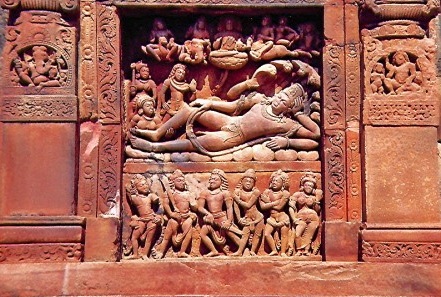
Vaishnavism in the heights
Vaishnavism and Saivism became popular in this period. Both marked by bhakti and ahimsa. It was believed that Vishnu sometimes comes to earth to help men lead good lives, and this is called an Avatara or Incarnation (as he takes an animal or a human form). Now the Brahmans explained that devotion to Vishnu through prayers and hymns was more important. Images of the gods were worshipped and placed in a small room which was called the Deva-griha. Images of Brahmanical gods and goddesses and Jain Tirthankaras and of the Buddha and Boddhisatvas were also made. Many of the older books such as the Ramayana, the Mahabharata and some of the puranas were added to or written at this time. They now came to be treated as religious literature. Gupta kings were either the worshipper of Vishnu or Shiva but most of them were Vaishnavas. They also performed religious sacrifices such as the Ashvamedha. Religious sacrifices were held in this period but not as often as in Vedic times. The kings gave donations for building temples. A large number of caves at Ajanta and Ellora were excavated belongs to this period.

Mathematical Contribution
In the field of mathematics and astronomy Aryabhatta wrote the Aryrbhattiya. He suggested that the earth revolves around the sun and rotates on its axis. Another noted astronomer was Varahamihira. By astronomical calculations they could predict the eclipses accurately. Surya Siddhanta is the best known work on astronomy in this period. Indian mathematicians used the decimal system and also introduced zero. The Indian system of mathematics and decimal system was adopted by the Arabs. From them it was learnt by the Europeans. 
Iron Pillar
The Arabs built their Islamic empire in the 7th and 8th century A.D. The sea and land routes came under their control. So the Arabs became the link between India and Europe. The iron pillar at Mehrauli in New Delhi built in the 4th century A.D. is a fine example of iron technology. Books on medicine were also written.

Literature

The period beginning a little before the reign of the Guptas ushered in the glorious period of Sanskrit literature, particularly secular. This was the greatest period of poetry and drama. The great writers of this period are well known–Kalidasa, Bhavabhuti, Bharavi, Bhartrihari, Magha and many others. Kalidasa lived for some years at the court of Chandragupta-II. Kalidasa’s most famous work is the Abhijanashakuntalam and poems like Kumarsambhava, Meghadutta and Raghuvamsha, provide a vivid picture of Gupta society.

Nalanda University
Among the other famous works of this period are Bhavabhuti’s Utter-Ramacharita, Bharavi’s Kiratrjuniya, Vishakhadatta’s Mudrarakshasa, Shudraka’s Mrichhakatika and the seventeen plays of Bhasa. Dandin wrote the Daskumaracharita. The subjects of these and other works were political events, romances, allegories, comedies and philosophical questions. Besides these, there was also a growing body of philosophical literature. There were also great collections of tales and stories. The most famous collections are the Panchatantra and the Kathasarit-sagar. The study of language, particularly grammar and lexicography, was very advanced. 

Art and Architecture

Dasavtar Temple
The Gupta period also marked the beginning of temple. These temples were not in the form of caves cut into the hills as at the Ajanta and Ellora, but were constructed of materials like brick and stone. The early temples were very simple, consisting of just one room where the image of god was kept. This was the Garbha-griha. Examples of these temples are at Bhitaragaon and Deogarh (Kanpur and Jhansi district of U.P.) and at Sanchi (Vidisha district of M.P.). The entrance to this room was decorated with sculpture. Gradually the number of rooms increased from one to two, three, four and many more until in later centuries, the temples became large and several buildings were included in the temple courtyard.

Gupta Architecture
There was a large Buddhist monastery at Sarnath near Varanasi. Here stone images of the Buddha have been found. Some of the Buddhist monasteries were in caves cut into hill sides. One of these was at Ajanta near Aurangabad. The walls of the caves were covered with paintings (murals) depicting the life of the Buddha. The varahavatar depicted in the Udayagiri cave is a very impressive one. More than a thousand caves from about the second century B.C. to tenth century A.D. were excavated in different parts of India. Most of them are Buddhist; some are Hindu and Jain. Beautiful chaityas (worshiping halls), Viharas (Monasteries), mandapas, rathas and cave temples have been cut out of rocks.